

Anthropic made a big announcement this week.
Well, sort of. They didn’t actually “announce” anything.
They quietly updated a help page on their support site saying that they will now watermark everything Claude writes.
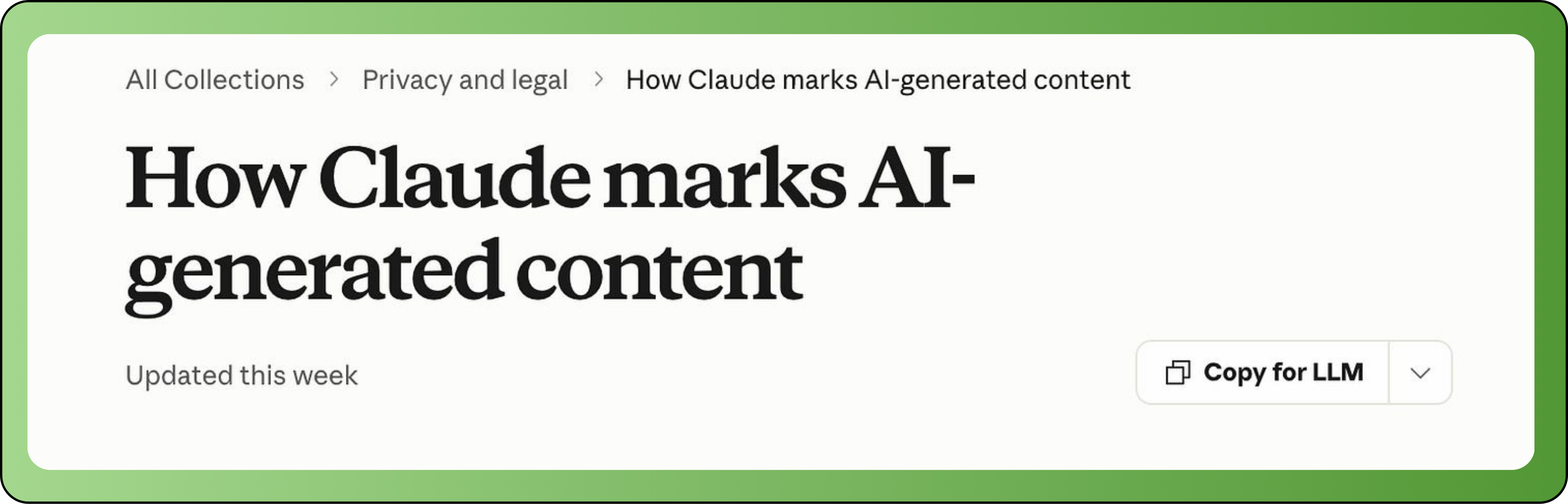
It’s designed to survive copy paste. There’s no setting to turn it off, and it applies worldwide.
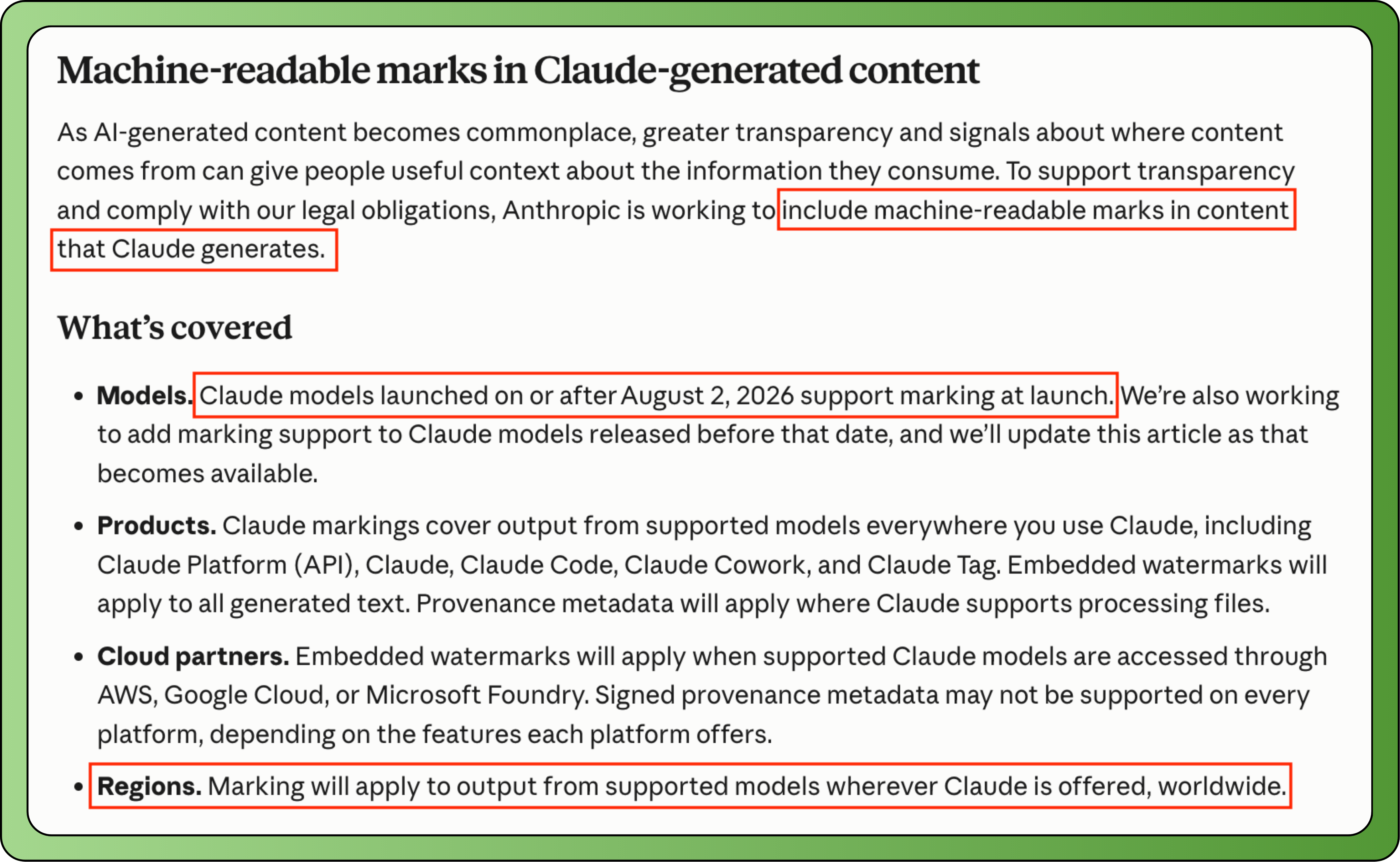
And not just to full AI drafts.. If you take a text you wrote yourself, and only asked Claude to proofread, that can carry the mark too!!
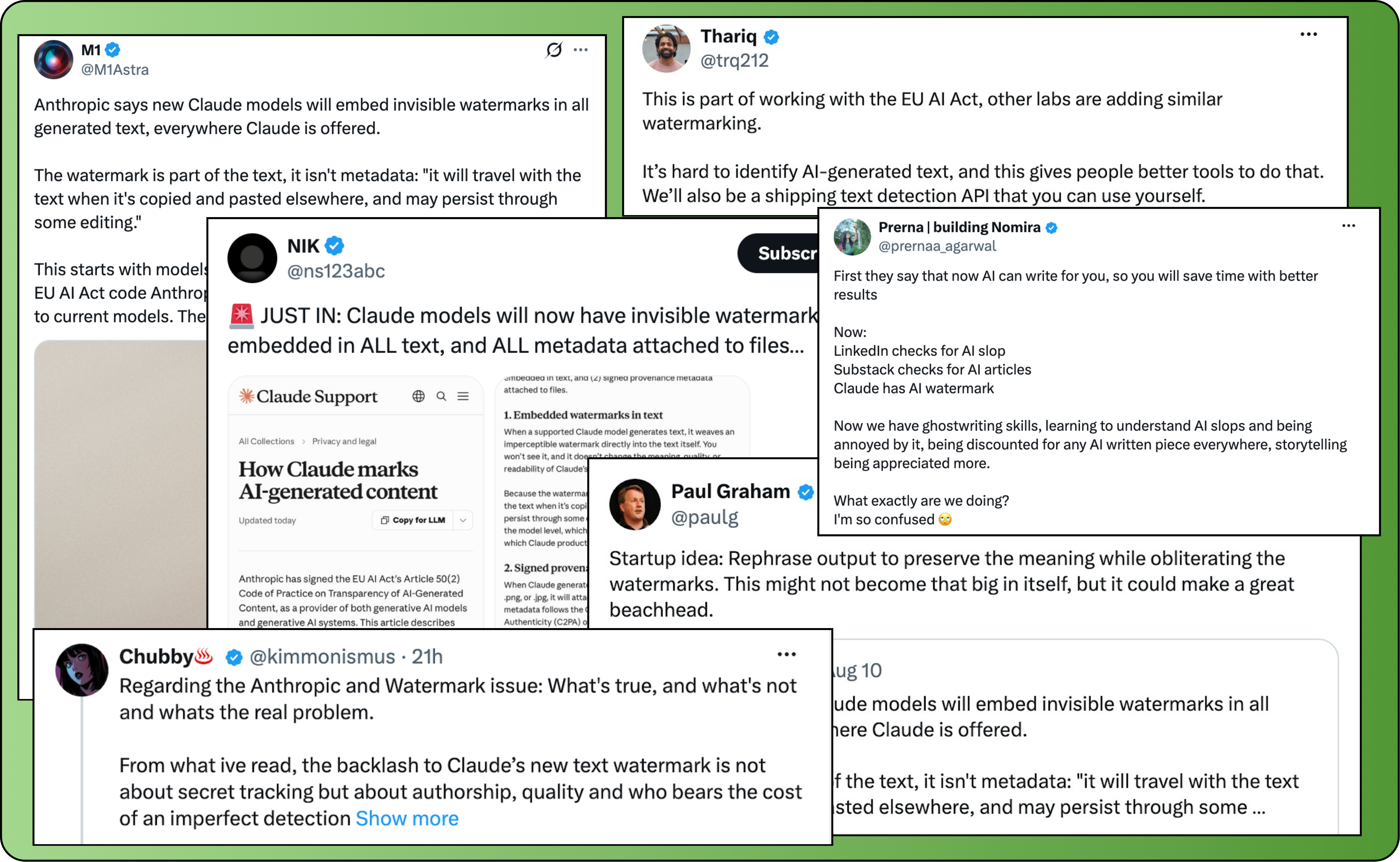
This has sent users on a frenzy..
I use Claude heavily, including researching and drafting this newsletter, so I sat down and read the documentation and then the EU law behind it. I wanted to know exactly what’s coming for people like us who use AI to write.
By the end of this you’ll know:
→ what the mark actually is (it’s not the regular watermark we know)
→ how does that impact you
→ whether anything you’ve written with Claude is already marked
This one’s detailed and full of screenshots, so Gmail might cut it off halfway. Click here to open it in your browser.
Before we go ahead, remember to share this with someone who uses Claude for writing.
I’ll be posting updates around this as the news evolves. Subscribe to follow along.
Okay, what’s going on here?
This European law says any company that builds generative AI has to mark whatever its systems generate so a machine can tell whether the text was generated or modified by AI.
More than 80 companies signed this. OpenAI, Google, Meta, Microsoft, Mistral, Cohere.. and Anthropic.
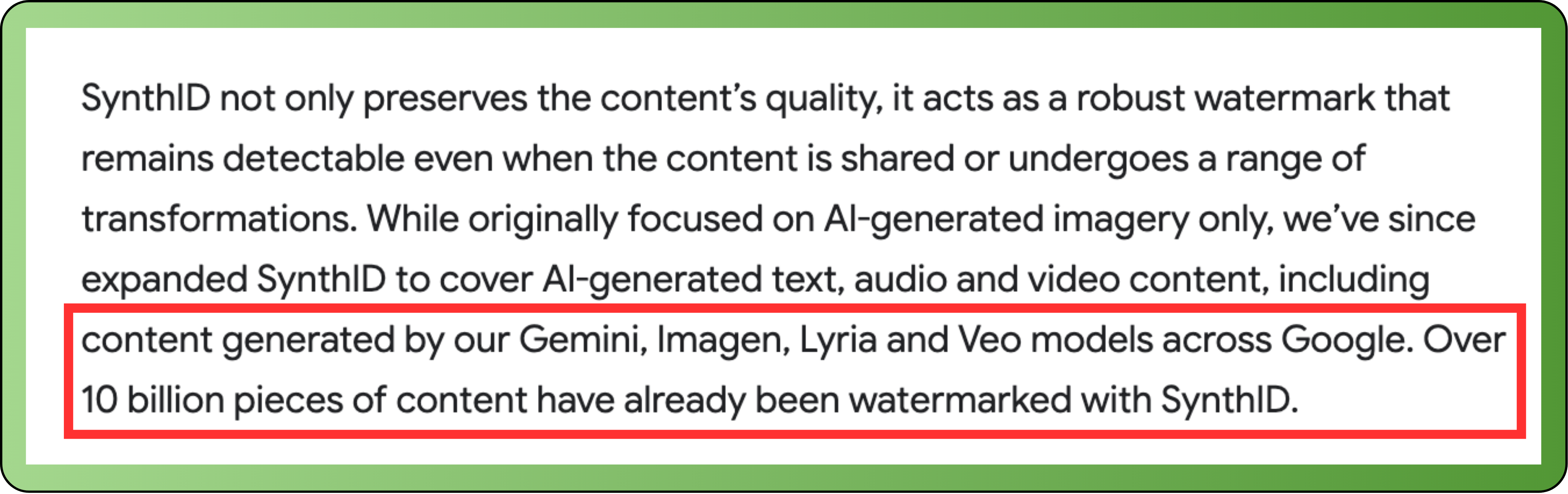
The idea itself isn’t new. Google has been marking Gemini's writing since May 2024.
What surprised me, however, was that this law is applicable only to Europe, but Anthropic extended this to cover every user across the world!!
But, what IS this watermark thing?
There’s a lot of confusion around this, so let’s clear that out first.
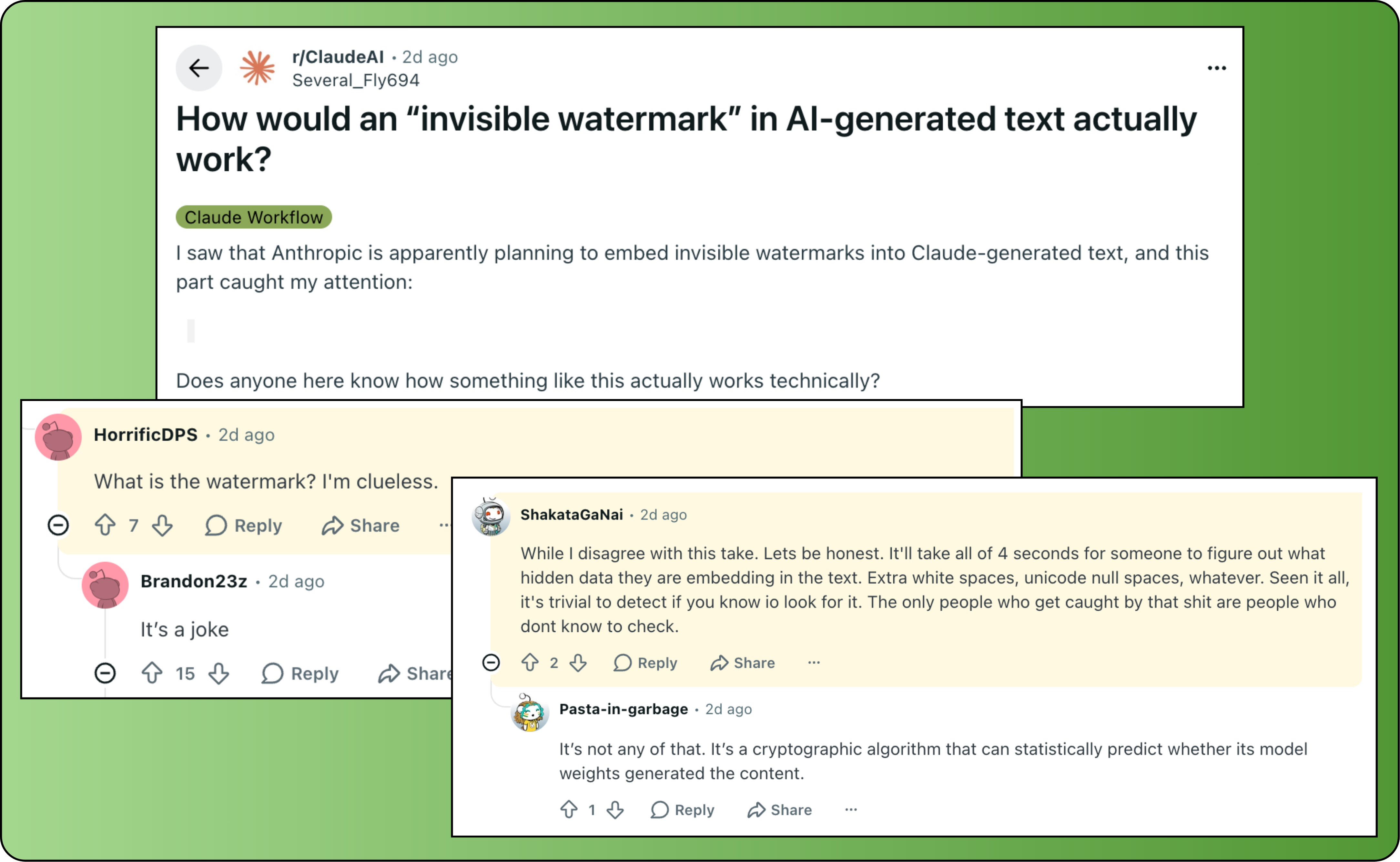
You hear watermark and you picture a faded logo stamped across a stock photo. Or some tag hiding inside a file.
AI-generated images contain a specific tag inside file metadata that tells that this image was generated using AI. Platforms like LinkedIn read that tag to detect AI generated images.

Text can’t work like that. A block of plain text has nowhere to attach a tag to.
So, the common misconception is that the watermark is probably some invisible character tucked between words that you can strip away if you knew what to hunt for.
It’s not.
The watermark is the pattern of words the AI picked.
Bear with me. Everything will get clear.
When an AI model is trained, it learns patterns like which words naturally come after another.
Given a prompt, it predicts the next word based on patterns it has learned during training. After generating the first word of the output, it takes the prompt + output it generated in the last step to predict the next word, and so on..
[Actually it predicts tokens which are smaller units of a word, but that’s not important here]
Think of this prediction game as a sophisticated autocomplete system, similar to your phone’s text prediction feature. When you type “I will be”, your phone suggests words like “there” or “home” because it has learnt that those are the most likely words to come after “I will be”.

The phone’s autocomplete is dumb because it doesn’t have a lot of context about the situation. AI models, however, can hold hundreds of thousands of words in its context, and guess the next word based on that which is why they sound coherent.
Say the AI is predicting the next word after: “This is great, the meeting was _________.”
During training, it would have learnt that ‘productive’, or ‘useful’, or ‘worthwhile’, will all work fine here.
Normally, the AI would pick ANY of these three words and continue.. This is why you get a different output every time, even though the prompt remains same.
With watermarking, these possible words are placed into two buckets, let’s say Bucket A, and Bucket B.
The AI is then nudged to quietly favour words from Bucket A.
The AI company (or anyone else they wish to share the bucketing strategy with) can then look at a paragraph and easily work out how many of the words came from Bucket A, and label your text “AI generated” if most of them are from there.
Does this mean that we can find out which words fall into Bucket A and avoid them? No. The bucket a word falls into depends on the context and the bucketing strategy.
Now, you might say, “Well, if the words from both A and B fit a slot equally well, then a human might write a sentence that contains words from the secret list, and their writing might be falsely labeled as AI.”
True.
However, the human has no idea of the bucketing strategy, so they’ll pick roughly half the words from A, and half from B. It’s highly unlikely they’ll pick much more than half of the words in a row from A.
So, the chances of being falsely labeled “AI generated” reduces as the length of text increases.
This makes watermarking highly effective.
As you would have understood, because the signature is embedded in the pattern itself, you can’t fix this by deleting any “hidden character“ in your text because there’s no character to delete in the first place.
Retyping the whole thing by hand does nothing either, because you’d be typing the same words back in, and the words itself carry the signature.
What if I change a few words here and there?
The chances of the writing being labeled “AI generated” might reduce, but it will still be watermarked if much more than half the words come from A.
There’s a silver lining though
Because the watermark lives in the sequence, short outputs can barely carry it. The EU code Anthropic signed sets a floor of 200 tokens (roughly 150 words), below which very short text isn’t expected to carry a detectable mark at all.
So, ultra-short form and short-form written content may not be marked.
Is my Claude content already being watermarked?
Nope.. not yet.
The models launched on or after August 2, 2026 will carry watermarking out of the box.
The models we use today (Fable, Opus, Sonnet) were launched before August 2nd, and they do not watermark text yet.
The models launched before will be also be updated to watermark, but we don’t know when. Anthropic’s page says “Existing models are in progress.” But, EU has directed that models that were already on the market before August 2nd have to comply by December 2, 2026.
So, all the content that you generate from Claude till their next model arrives or till they retrofit watermarking on the existing models, there’ll be no watermark.
I’ll do an in-depth article whenever Claude starts watermarking. Subscribe to stay updated.
How does this impact me?
Even once watermarks are rolled out, short-form content like LinkedIn posts, and Substack notes should mostly be fine. Most of these run under 150 words. There just aren’t enough words in them for a pattern to show up.
Long form will carry it.
Newsletters, blog posts, anything running a few hundred words or more.
So will your client work.
Proposals, reports, strategy docs, ghostwritten articles.
And, it doesn’t matter how much of it was actually written by you. You could write every single word yourself and ask Claude to fix your grammar. What it hands back can still carry the mark. Anthropic says this on their own page:
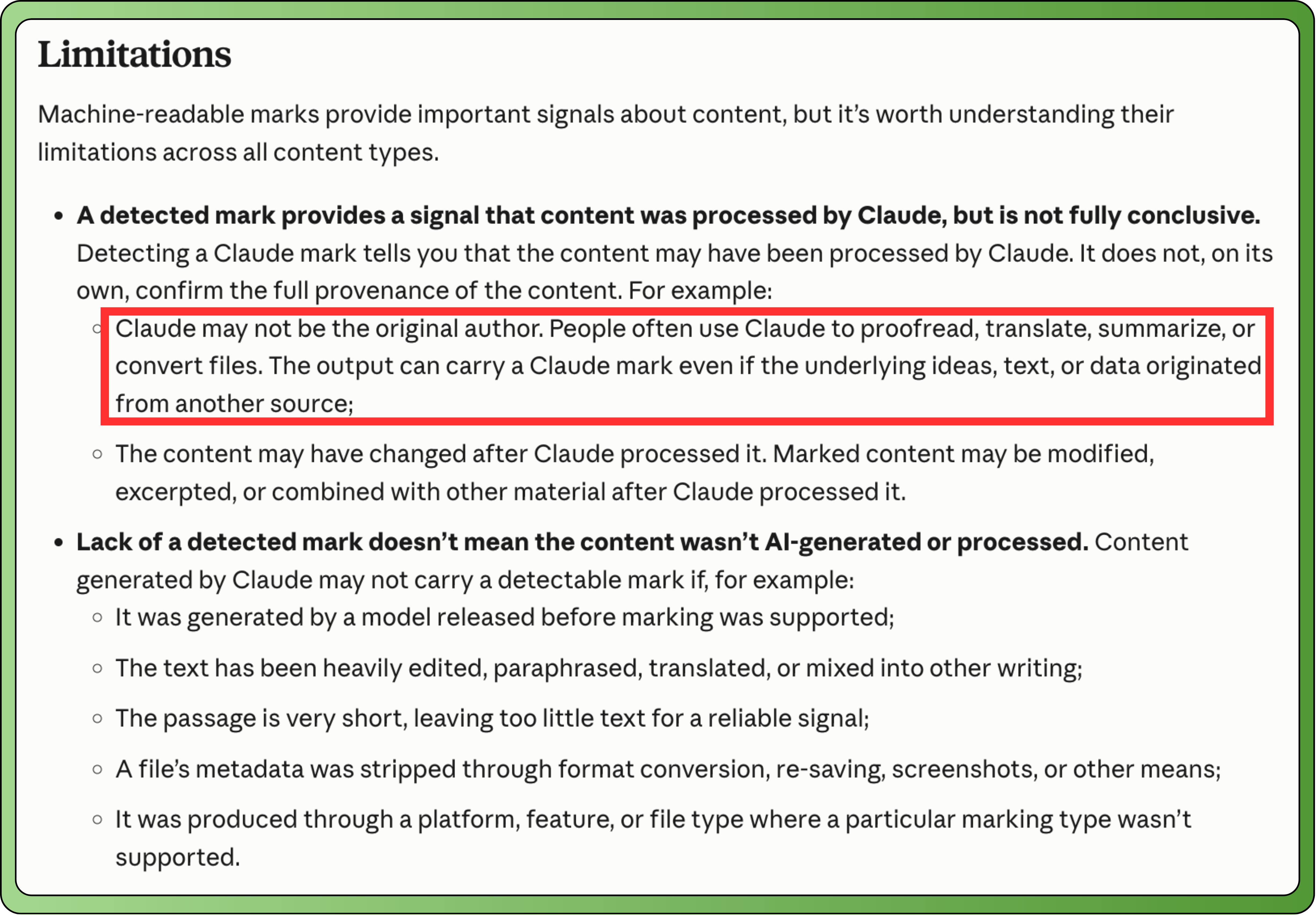
The mark only records that Claude touched the words. It says nothing about who did the thinking.
Do NOT fall for products selling you a solution
Within two days of this news, watermark removers started showing up.
Most of them just strip invisible characters, which we’ve already established isn’t the watermark, or rewrite the content using another AI (which will carry its own watermark).
Until Anthropic publishes its verifier, nobody outside Anthropic can honestly confirm that a passage contains or no longer contains the watermark.
Don’t pay for any of it.
So, should I stop using AI for writing?
No.
If you’re trying to build a solo business, juggling a million things, AI is your leverage.
Maybe, you need to change the way you use it.
Most of the AI content out there today looks like slop because the person typed in a lazy prompt, and posted whatever it threw. I see this all the time in my comments.
Here’s what I do:
Step 1: Ask the AI to research all the relevant details around the idea, research papers, white papers, guidelines, laws, etc.
Step 2: Read through the relevant docs so I gain a point-of-view.
Step 3: Provide a rough direction of what I’m thinking. Toggle voice mode and dump whatever comes to mind. This is where my POV gets fed into the AI. NEVER outsource the first thinking to the AI.
Step 4: Brainstorm additional directions we can take, and finalize.
Step 5: Think of the outcome I’m trying to deliver to the reader. What should the reader be able to do or think about differently after reading.
Step 6: Make a list of things the article has to deliver for Step 5 to be true.
Step 7: Inject my context (thinking, life experience, judgement, writing style, words I like, curse words I use, etc.) to the prompt.
Step 8: Generate the first draft.
Then I keep working on it, feeding it more of my context, until it sounds like me and thinks like me.
I know it’s a lot of work to include all the relevant details into a prompt, so I’m working on a way to make this easy. Will let you know. Watch out!
The goal is not to be labelled as “not AI assisted”.
The goal is to provide value. If I can help a consultant/coach earn more and save 10 hours a week using AI, they won’t care whether I used AI to write the newsletter.
The goal is to tune the AI to think like you, understand your business, and sound so f**king natural, that people wonder how you’re getting an output so good, and all they’re getting is trash..
Focus on delivering value. Let everyone else worry about the watermarks.
The best of my morning reading today: this article.
Welcome to the Luddite Summer … and probably longer. Next stop, no spell check. I’m looking forward to going back to my grad school era dot matrix and daisy wheel printer … no wait, scratch that, my parent’s Royal typewriting … no wait, not allowed. Get my great grandfather’s quill pen … wrong - get rid of that infernal Gutenberg printer and we can let clerics vet, write and distribute all text. Now that would be a lot better world for sure.