

[Folks, DeepWriting is now The Crest]
I just broke down 25,083 posts from the biggest names on LinkedIn, many of whom run multi-million dollar businesses.
I wanted to understand their playbook, so we can replicate some of that..hee hee!!!
Here’s what I found: They all follow the same strategy to get more customers and print money.
You see, I am an AI nerd with 0 creativity and marketing skills. And it’s hard to grow a solo business if you suck at marketing. So, I use AI to make things easier, and I share what I learn.
By the end of this article
→ you'll have the exact playbook they follow
→ and a prompt that creates a kickass content strategy for your business.
Let’s go!!!
Quick basics before we get to the playbook these guys follow
Back in 1966 an ad man named Eugene Schwartz figured that a person goes through 5 stages before they buy from you. Yes, five!!!
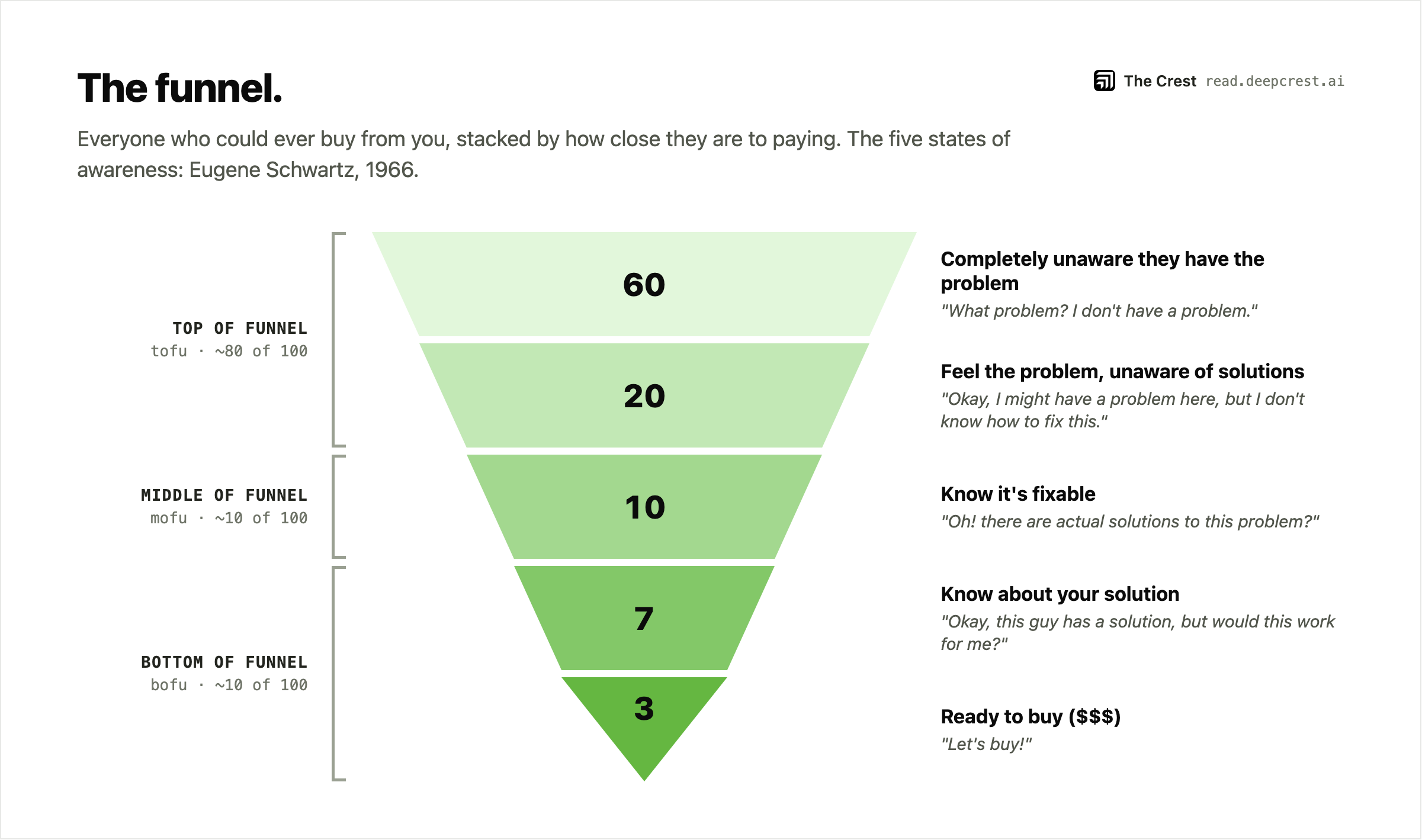
→ Stage 1: completely unaware that they even have the problem you solve. “What problem? I don’t have a problem.”
60% of the market is at this stage
→ Stage 2: feel the problem but are unaware of solutions. “Okay, I might have a problem here, but I don’t know how to fix this.”
20% of the market is at this stage
→ Stage 3: know it’s fixable. “Oh! there are actual solutions to this problem?”
10% of the market is at this stage
→ Stage 4: know about your solution. “Okay, this guy has a solution, but would this work for me?”
7% of the market is at this stage
→ ready to buy ($$$). “This dude gets my problem, and has a solution perfect for me. Let’s buy!“
Only 3% of the market is at this stage
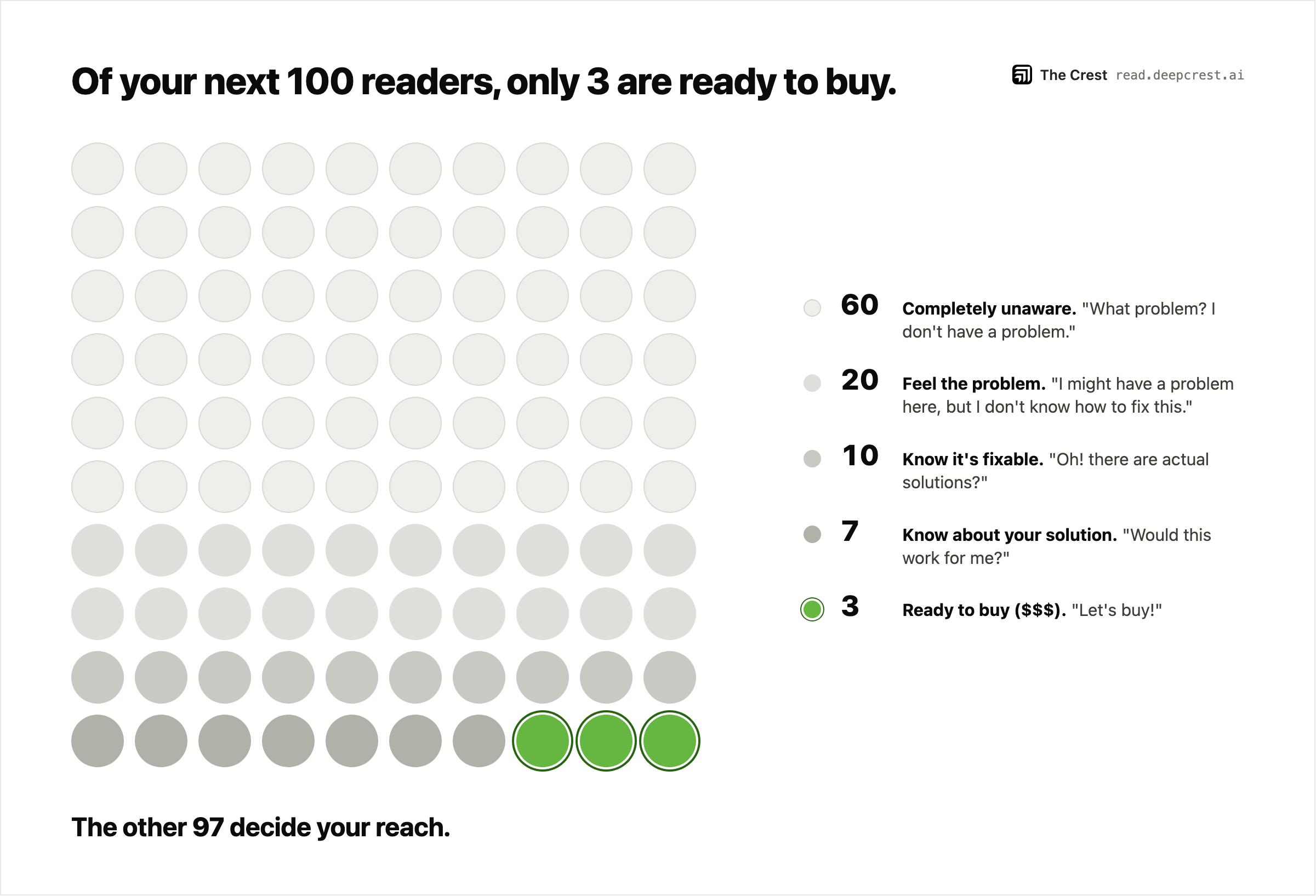
If every thing you post is ultra-niche and targeted towards the bottom 2 layers (your ideal customer persona), you’ll miss a huge chunk (60-80%) of your future customers (and $). No bueno.
“How do I fix this?” Glad you asked.
Content strategy to convert strangers to buyers
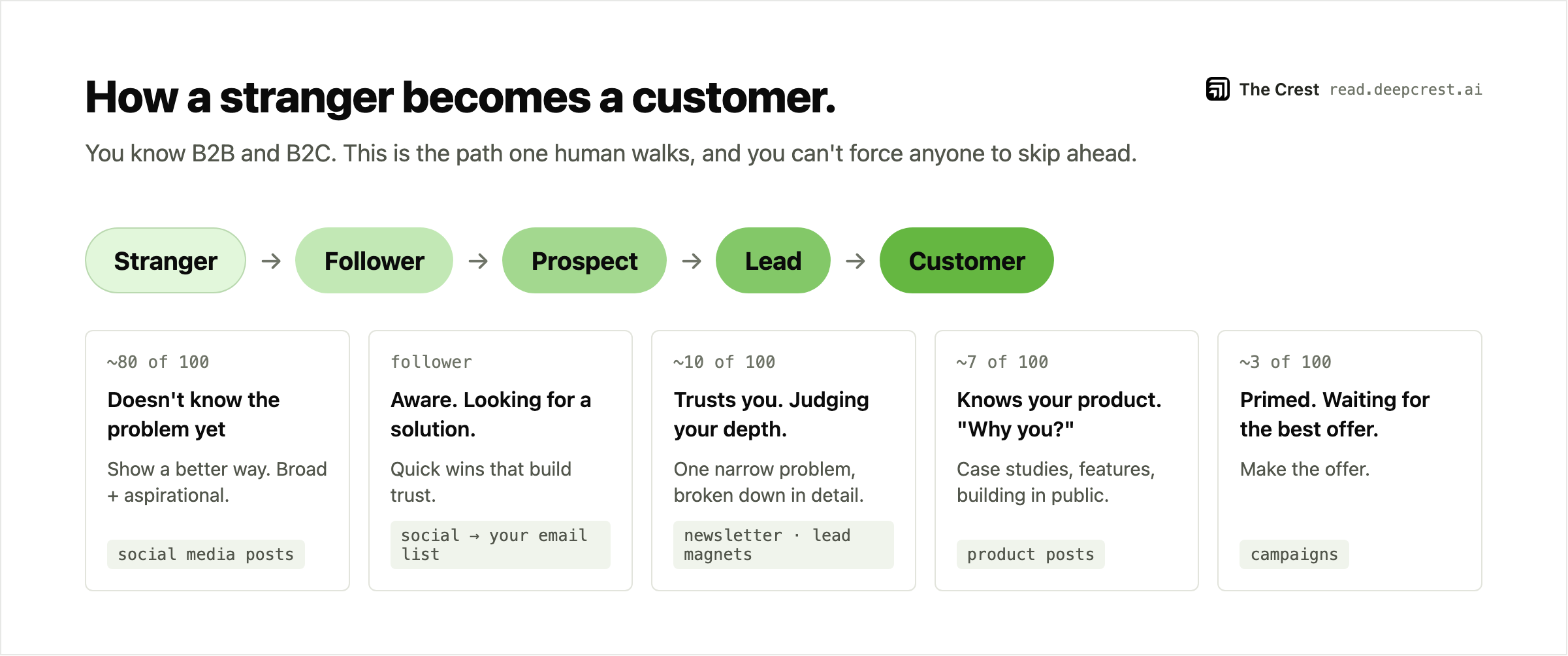
1. targeting the problem unaware prospect (top of funnel)
Goal: stranger → follower
These people are completely oblivious that they have a problem. Ignorance IS a bliss sometimes.
We want to move these people from “what problem? I don’t have a problem”, to “okay, I might have a problem here”.
And the best way to do that is by showing a better way/solution to the problem they never thought they had.
“How to get a six pack in 90 days without ever going to the gym”
“How The Fictional Company cut customer support costs by 60% and reduced turnaround time from 36 hours to 15 minutes”
“How to start a consulting business and earn more than your job in 6 months“
They should think “Seriously? That’s possible?”
And the best format to target these people is through social media posts with strong hooks which can be consumed in 30 seconds.
Like this:
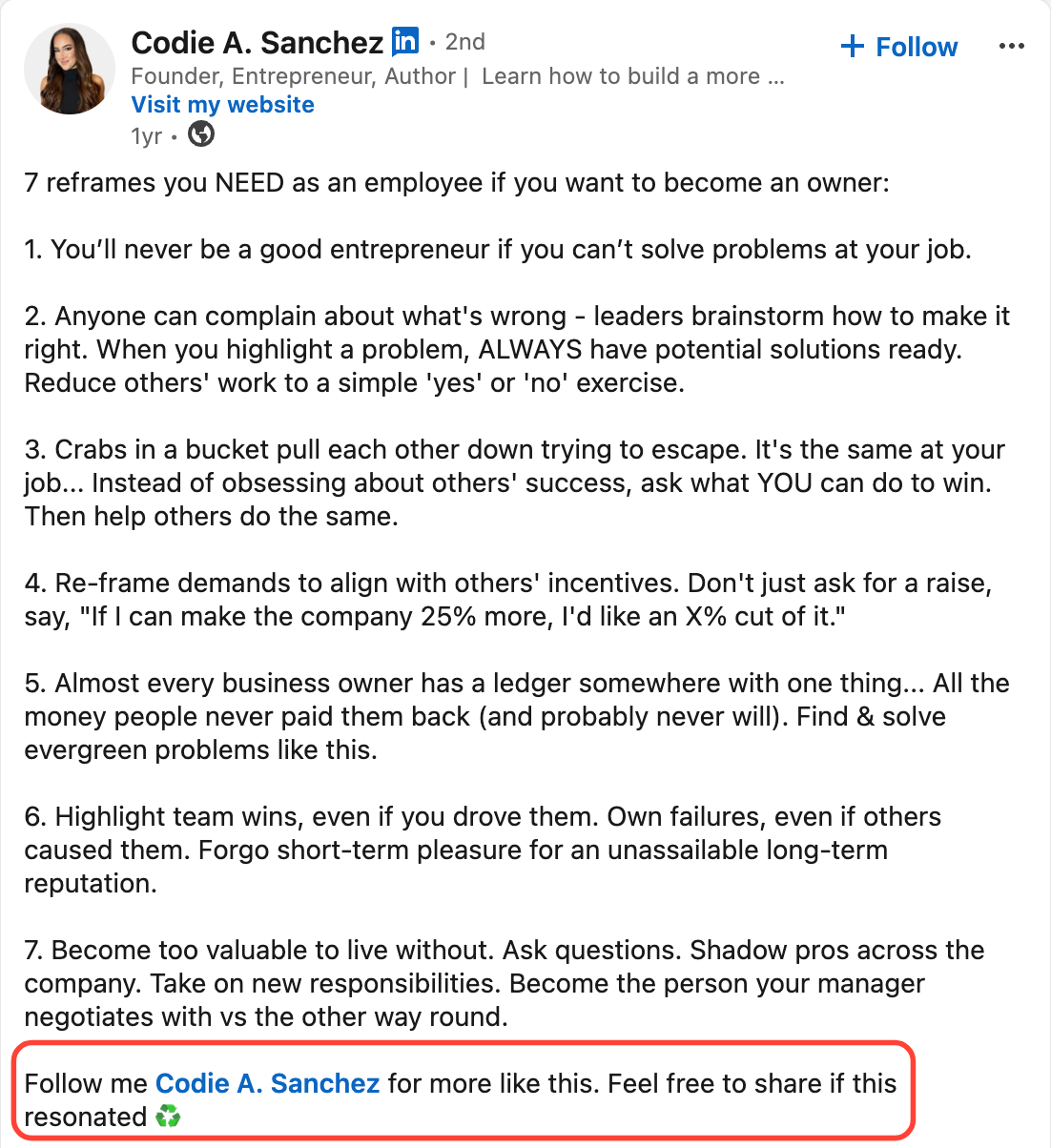
Goal: get them to follow us so we can show up in their feed, and bring them into our sphere of influence.
#2. targeting the problem aware prospect (top of funnel)
Goal: follower → prospect
Once someone becomes aware of a problem, or a better way to do something, they start looking for a solution.
We want to give them quick wins that reinforce their trust in us. This can be content like:
“How to find a good domain name (that’s available) using AI“
The best format to target these people is through social media posts with an occasional CTA like:
“I talk about [XYZ] in much more depth in my newsletter. Join 3k others“
Goal: get these people from the social media platform to our email list, so we land in their inboxes directly bypassing the ‘algorithm’. Sphere of influence, level 2!
Like this:
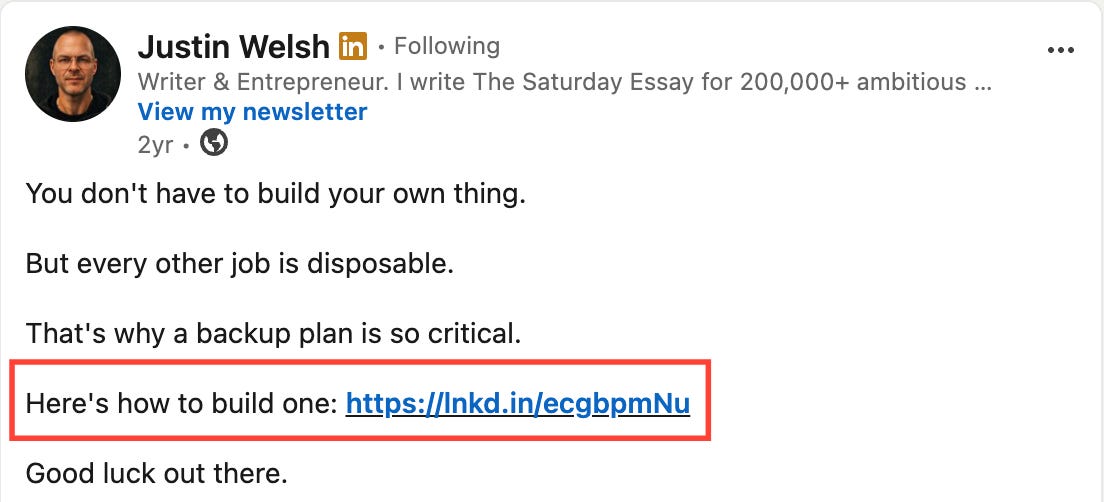
The goal with top-of-funnel content (both Problem Unaware and Problem Aware) is to reach more people. Do not go deep into the niche. Keep it broad and relatable.
On social media, we target people who are not yet fit to buy our product or service, because:
when they like and share what we say, the content reaches more people, including the people who are ready to buy.
they themselves get ready to buy as they interact with our content
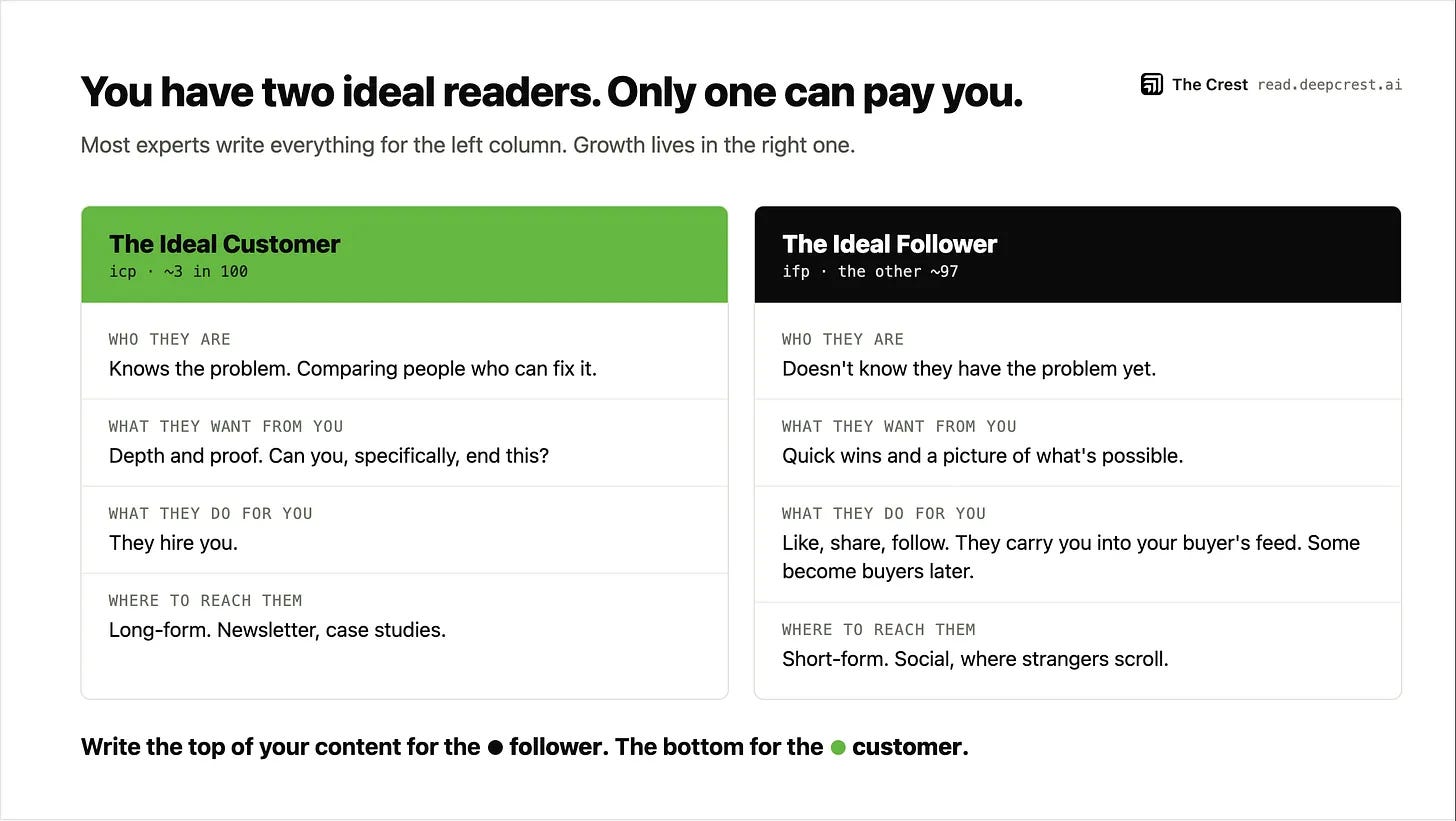
If a coach helps B2B businesses grow on LinkedIn, talking about the technicalities of growing a B2B SaaS on LinkedIn would not interest most of the B2B SaaS founders out there because they are not worried about growing on LinkedIn.
They are worried about getting more sales. The way we pull them into our territory is by showing how LinkedIn can help them get more sales, and why they should be looking at LinkedIn as a platform to grow their business.
For a dentist, instead of talking about myths about braces, talk about something more broad like dental hygiene routines.
For a workplace lawyer, instead of talking about the steps you should take if you’re terminated, talk about what are three signs your boss is toxic and what the law says about it.
#3. targeting the solution aware prospect (middle of funnel)
Goal: follower → prospect
Now that they have seen the quick wins, they trust us and can appreciate the deeper layers of our expertise.
We convert the trust to authority by breaking down a narrow problem in much more detail. A narrow problem is something specific, something narrow, which, once solved, leads to a larger, more complex problem that our core offer solves.
The best way to talk to this persona is through long-form (LF) newsletters or lead magnets.
Like this:

Once we show how to generate ideas from Reddit (solving a narrow problem), they can immediately apply that to save time. But then they soon realize there are other parts of the process that still drain time.
That is where our full product comes into picture.
#4. targeting the product aware prospect (bottom of funnel)
Goal: prospect → lead
Once they are aware of the solution, we want to make them aware of our products and services.
And we also want to answer the question for our ideal customer: “why are we the best choice?”.
The best way to talk to these people is to talk about our product or offer once in a while. We can talk about the features, case studies, learnings, building in public, etc.
Something like: “How DeepCrest helps you build authority online even if you suck at marketing“
Like this:
#5. targeting the most aware prospect (bottom of funnel)
Goal: lead → buyer
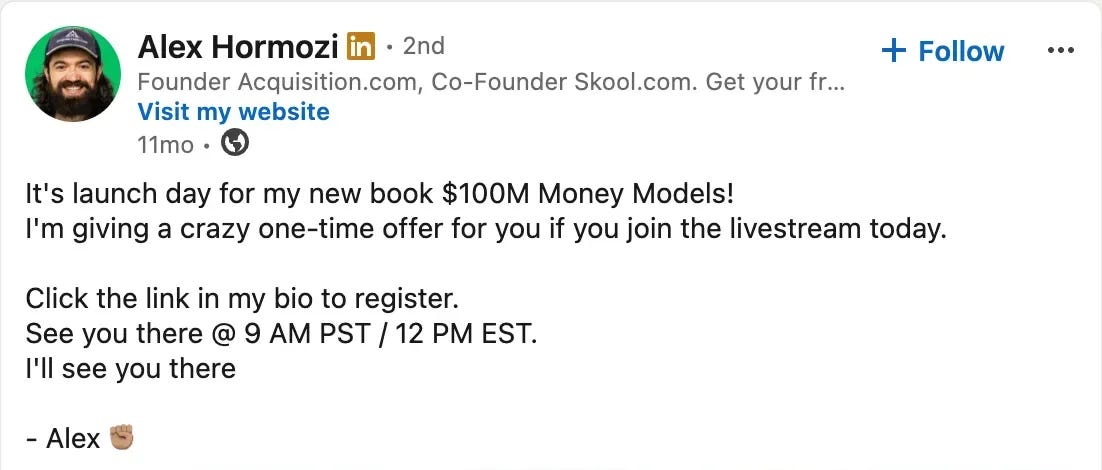
A small subsection of people who get all the way to the last stage are primed to buy our product or service and are waiting for the best offer.
The best way to get them to buy is through campaigns.
Like this:
The 7-2-1 rule best in the business follow
Now, that you know there are 3 broad stages, time to decide how much content to target each stage.
Let’s not guess and simply copy what works.
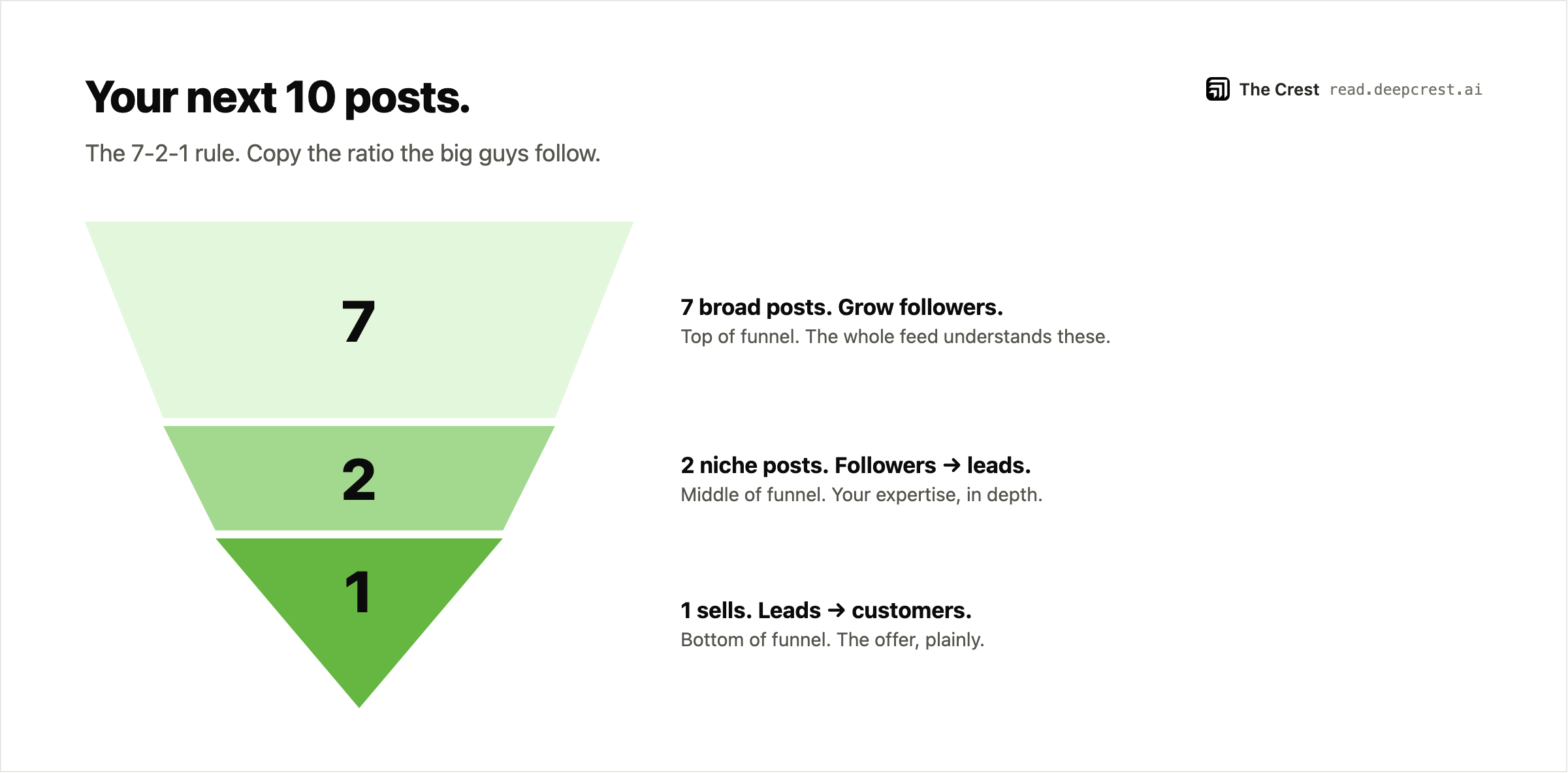
On average, out of every 10 posts the big guys publish..
7 is broad content intended to grow followers (Top of funnel)
2 is niche content to convert those followers into leads (Middle of funnel)
1 converts those leads into customers (Bottom of funnel)
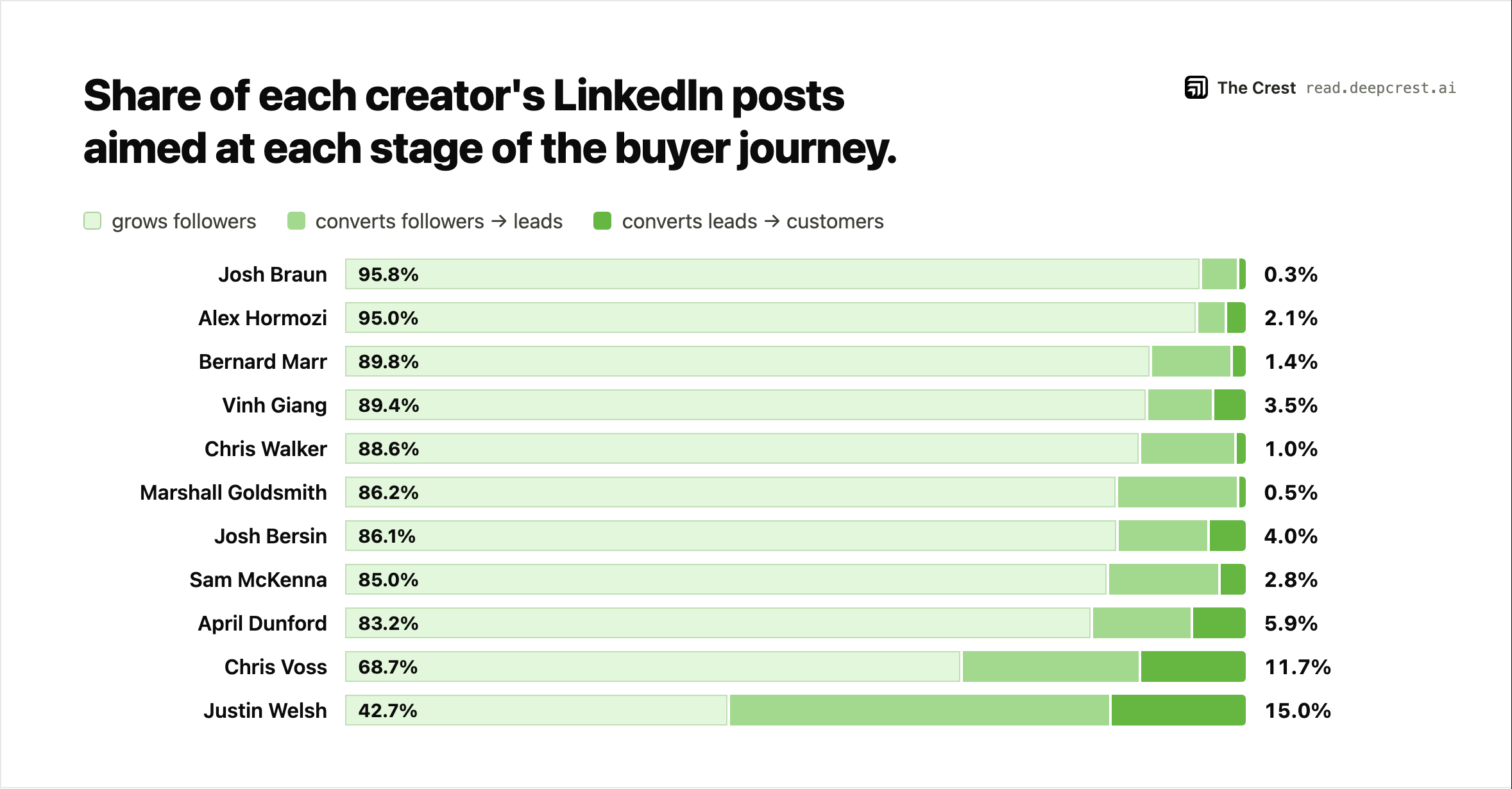
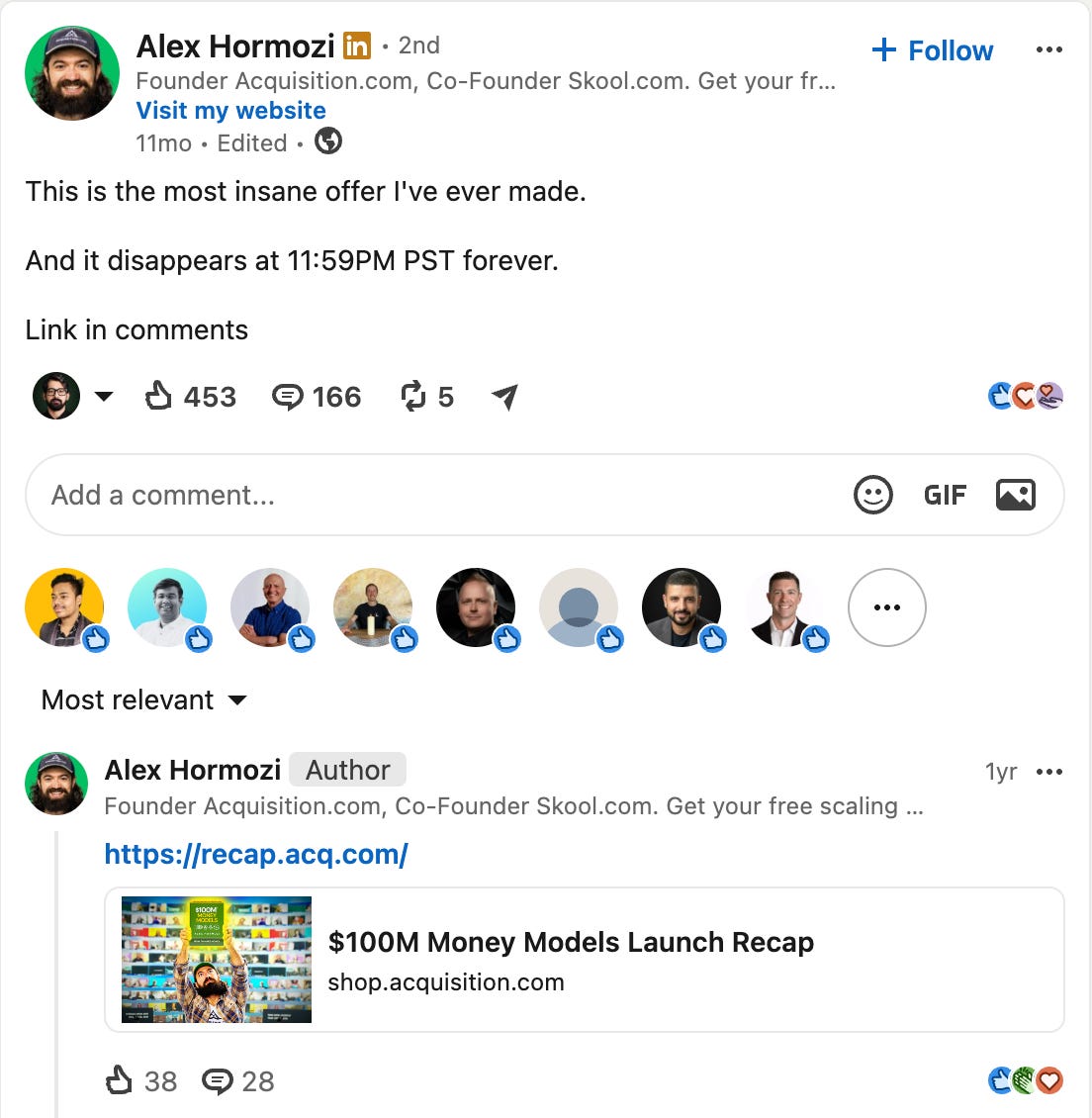
Hormozi literally wrote the book on offers. And 95% of his posts is broad. Ninety. Five. Percent!!
If you do not have any significant following yet, keep 80 to 90 percent of content broad to target the top of funnel and make it as wide as possible.
Build your content strategy in 20 minutes
Knowing the playbook is half the game. The other half is building your own.
So I turned everything above into a mega prompt.
It’s too big to paste it here. Click here to get it.
Paste it into ChatGPT, Claude, whatever you use and answer the questions.
It will generate an awesome content strategy you can use for your business. Enjoy!!!
Then come back and tell me in the comments what it mapped for your niche.
Last thing
In the next issue, I’ll take one big creator and decoding their entire content strategy. Post by post: who they’re targeting, what emotions they trigger, what hooks they use..
You pick who. Drop a name in the comments.. any leader in your space whose reach you’d love to have. I’ll break it down.
Lara Acosta
Brian Clarke - creates projects centered around solo entrepreneurship and thought leadership, including Further and Leading Expert. Formerly Copyblogger CEO